You notice it on a normal drive. The fuel gauge drops faster than it used to. The engine feels slightly uneven at idle. Then the amber engine light comes on, and suddenly a small issue feels expensive.
For a lot of UK drivers, that trail leads to one overlooked part. The oxygen sensor, often called a lambda sensor. It’s small, threaded into the exhaust, and easy to ignore until it starts feeding bad information to the engine computer.
If you’ve ever asked what is an oxygen sensor in a car, the simple answer is this. It measures how much oxygen is left in the exhaust after combustion, then helps the car adjust fuelling so the engine runs cleanly and efficiently. When it’s working properly, you’re more likely to get sensible fuel economy, smoother running, and a better chance of passing the emissions part of the MOT. When it isn’t, the car can get thirsty, rough, and awkward to diagnose.
The Unsung Hero of Your Engine's Efficiency
A good example is the car that still starts, still drives, and doesn’t sound dramatic, but somehow feels “off”. You fill up more often. The idle has a faint wobble. The MOT date gets close, and you hope the warning light was nothing serious.
That little sensor in the exhaust often sits right in the middle of those problems.
The oxygen sensor has been part of modern emissions control for a long time. It was first introduced by Bosch in 1976 and became mandatory on new UK car models by 1993 to comply with EU emissions standards. That shift mattered because UK MOT exhaust checks became stricter from 1991, and the wider use of oxygen sensors helped reduce road transport nitrogen oxide emissions by 45% between 1990 and 2000, as noted in this oxygen sensor history overview.
Why it matters to a driver
The sensor itself isn't the primary concern. What matters is what it affects:
Fuel spend: If the engine gets the mixture wrong, it can use more petrol than it should.
MOT stress: A bad sensor can push emissions out of spec.
Driveability: Hesitation, uneven idle, and lazy response often start with bad data going into the ECU.
Catalytic converter health: If fuelling stays wrong for too long, the cat can suffer as well.
A healthy oxygen sensor helps the engine make small corrections all the time. That’s why such a tiny part can have such a noticeable effect on how the whole car feels.
In plain terms, the sensor is part referee, part messenger. It watches the result of combustion, then tells the engine computer whether things are too rich, too lean, or close to ideal.
How an Oxygen Sensor Works Inside Your Car
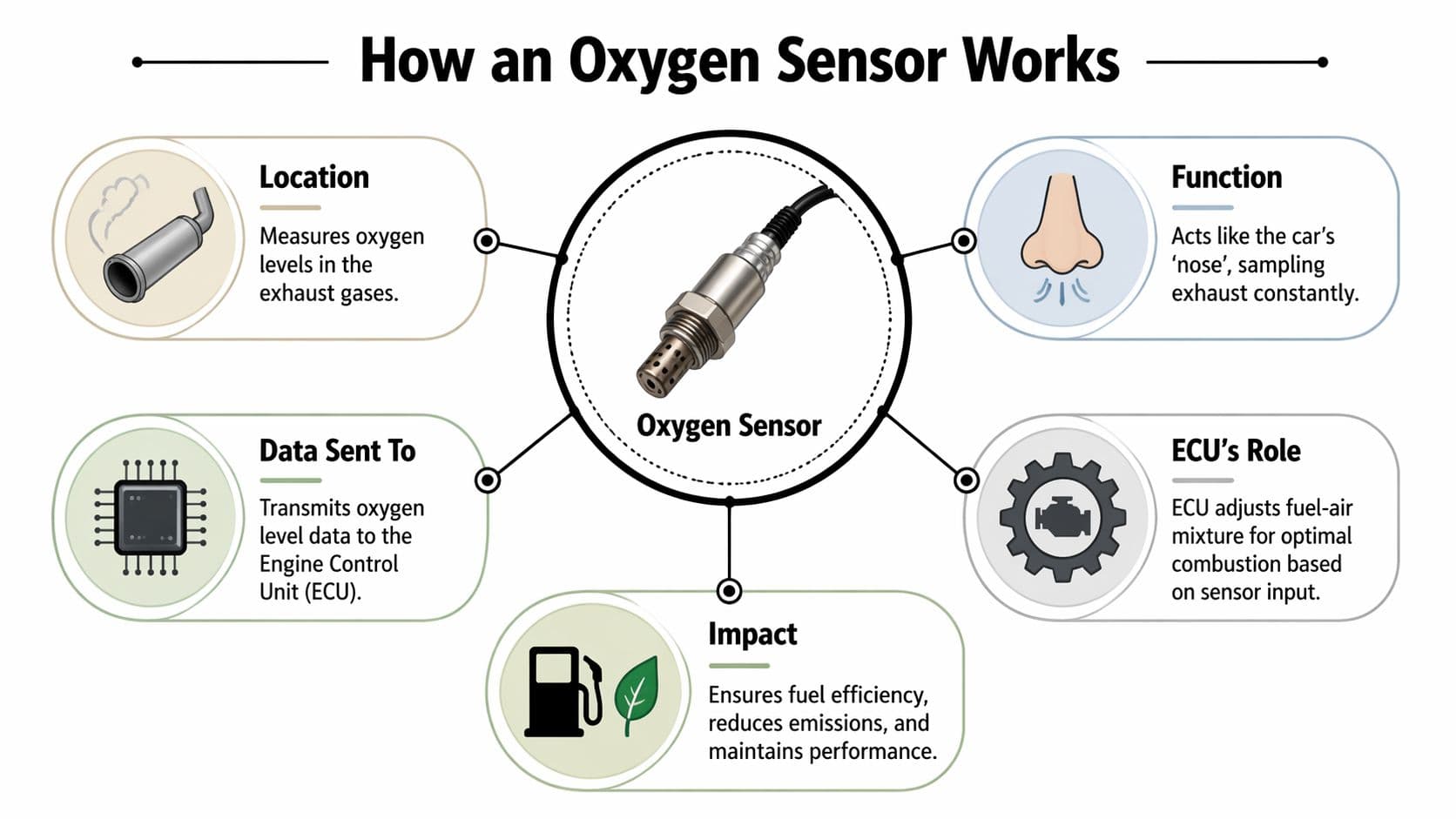
The oxygen sensor reads how much oxygen is left in the exhaust after combustion, then sends that information to the ECU. The ECU uses that signal to make tiny fuel corrections, over and over, so the engine stays close to the mixture it was designed to run.
If there is very little oxygen left in the exhaust, the engine has usually been running rich, with more fuel than needed. If there is more oxygen left over, the engine has usually been running lean, with too little fuel. That feedback matters because the engine and the catalytic converter work best when the mixture stays near the target point.
The air fuel ratio that matters
For a petrol engine, the target is usually around 14.7:1, which means 14.7 parts air to 1 part fuel. That is the point where the engine can burn fuel cleanly and the catalytic converter can work properly, which matters if you want clean emissions, decent fuel economy, and fewer surprises at MOT time.
Too rich, and unburnt fuel goes into the exhaust. Too lean, and combustion and emissions control suffer in a different way. The sensor helps the ECU keep correcting around that target instead of drifting too far either side.
How the sensor creates a signal
Inside many common sensors is a zirconia element. You do not need to remember the chemistry to understand the job. The useful part is that the sensor produces a voltage when the oxygen level in the exhaust differs from the oxygen level in outside air.
Here is the basic pattern:
Mixture condition | Typical sensor voltage | What it means |
Lean | 0.1 to 0.2V | More oxygen in the exhaust |
Rich | 0.8 to 1.0V | Less oxygen in the exhaust |
That signal switches very quickly during normal running, allowing the ECU to keep trimming fuelling as conditions change, as explained in NGK’s oxygen sensor guide.
What closed loop control means
When the engine is cold, the ECU starts out using preset values. Once the sensor has heated up and begins sending a reliable signal, the car moves into closed loop control. In plain English, the ECU stops relying mainly on estimates and starts reacting to what is coming out of the exhaust.
That is why a tired sensor can cause small but annoying problems. The engine computer is still trying to do its job, but it is working from slow or inaccurate feedback.
Practical rule: The oxygen sensor does not measure how much fuel went in. It checks how much oxygen came out, and the ECU uses that result to decide whether to add or reduce fuel.
Why heated sensors matter
Modern oxygen sensors are usually heated so they reach working temperature sooner after startup. That gives the ECU live feedback earlier, which is especially useful on short journeys, cold starts, and stop-start driving around town.
For a UK driver, that has real-world benefits. The engine spends less time running on guesswork, which helps fuel consumption, keeps emissions under better control, and reduces the chance of problems that could lead to MOT trouble or trigger warnings on cars already close to ULEZ compliance limits.
Upstream vs Downstream The Two Types of Oxygen Sensor
Often, many buying mistakes happen. People know they need “an O2 sensor” but don’t realise the car may have more than one, and they don’t all do the same job.
The manager and the inspector
The easiest way to separate them is this:
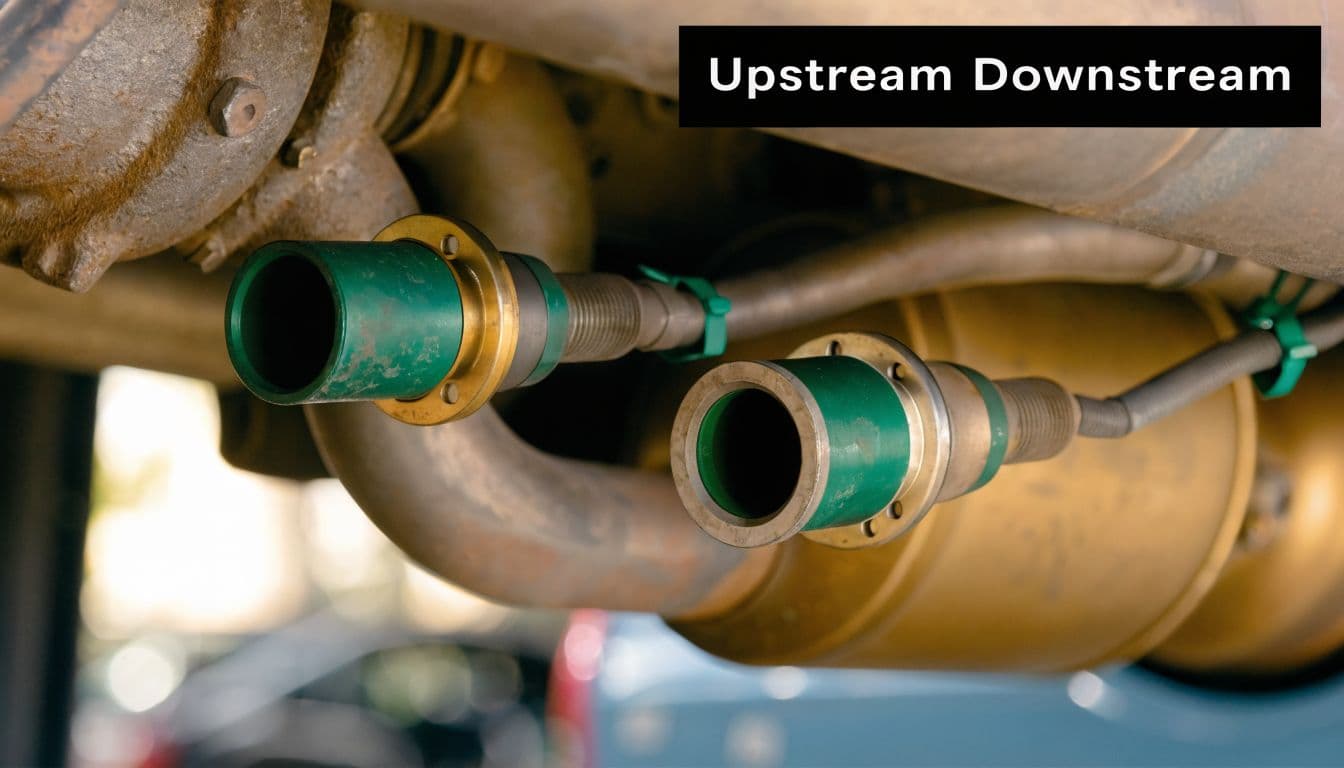
Upstream sensor: Fitted before the catalytic converter. This is the one the ECU uses to control fuelling in real time.
Downstream sensor: Fitted after the catalytic converter. This one mainly checks how well the converter is doing its job.
Think of the upstream sensor as the manager. It makes the important running decisions possible. The downstream sensor is the inspector. It checks the outcome.
If your catalytic converter is under suspicion, it helps to understand that the rear sensor is there to monitor converter performance. If you need context on where that part sits in the exhaust system, this catalytic converter page shows the related component clearly.
Why they are not interchangeable
They may look similar. They are not automatically interchangeable.
The front sensor has a direct fuel-control role, so response speed and calibration matter. The rear sensor has a different monitoring role. Fit the wrong sensor in the wrong place and you can end up with:
Persistent warning lights
Poor running
Fault codes that won’t clear
Failed emissions checks
Older and newer designs
You’ll also come across differences in sensor design. Older styles are slower to warm up. Later heated and planar types get to working temperature more quickly and offer faster feedback.
That’s why matching by vehicle registration, engine code, and sensor position matters more than buying by appearance alone. Two sensors can share a thread size and connector style yet still be wrong for the job.
Signs Your Oxygen Sensor Is Failing
A failing oxygen sensor rarely announces itself with one neat symptom. More often, it creates a cluster of annoyances that build gradually.
The signs drivers usually notice first
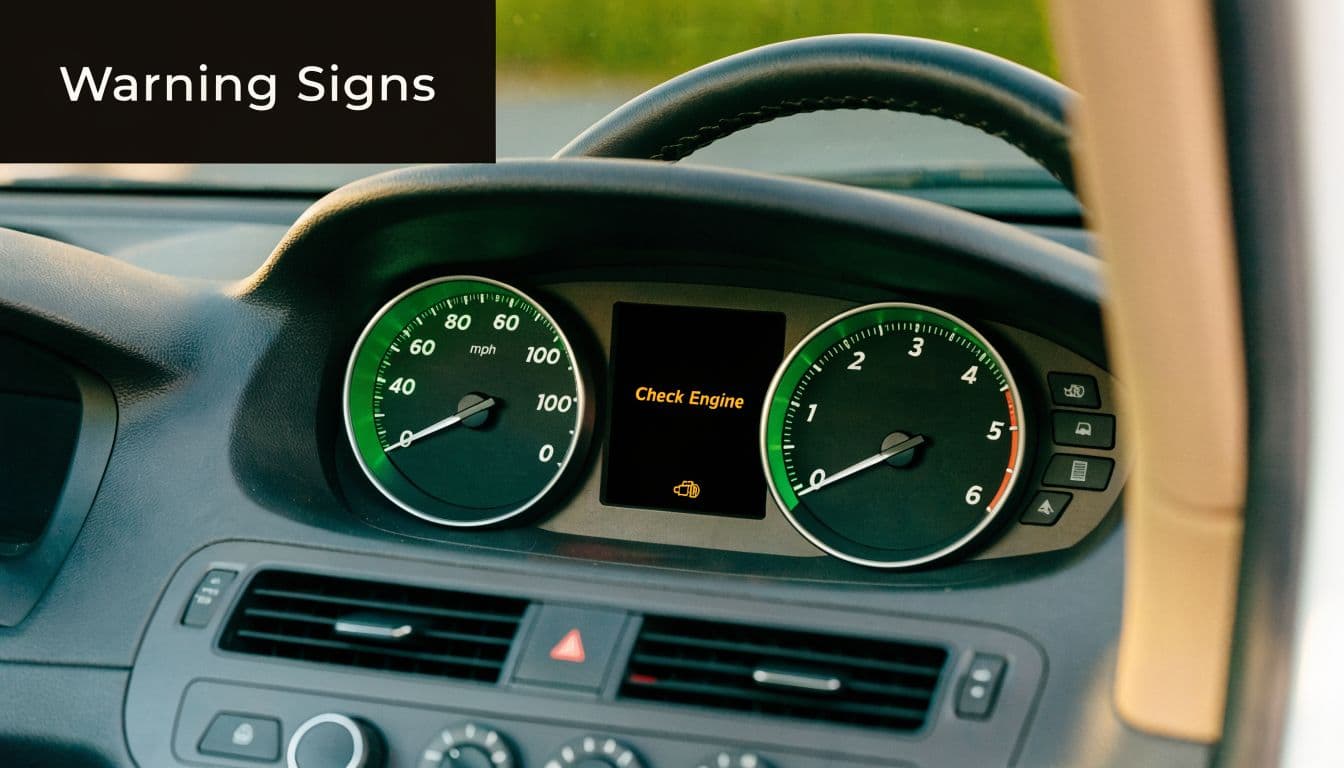
The most obvious one is the check engine light. But plenty of drivers notice the fuel bill before they notice the lamp.
You might also feel:
Poorer fuel economy: The ECU may overfuel if the sensor signal is wrong.
Rough idle: The engine can wobble or hunt at idle when mixture control is off.
Sluggish response: Throttle input feels less sharp than usual.
Failed emissions test: The car may run well enough to drive but still miss the required standard.
Sooty or darker exhaust signs: Rich running can leave clues at the tailpipe.
In the UK, emissions-related failures accounted for 8.2% of all car MOT fails between 2024 and 2025, which meant over 1.2 million vehicles failed their initial test, according to this MOT-related oxygen sensor article. That matters because even a sensor fault that feels minor on the road can become expensive at test time, especially once you add the £54.85 MOT fee and possible retest costs from the same cited source.
Why the symptoms can be misleading
A bad oxygen sensor doesn’t always mean the sensor is the root cause. Wiring faults, contamination, exhaust leaks, or catalytic converter problems can produce similar symptoms.
That’s why “my car is using more fuel” is a clue, not a conclusion.
If the engine is getting bad exhaust feedback, it may still try to compensate. The result can be a car that runs, but never quite runs right.
A quick explainer can help if you want to see the warning signs in action:
SYMPTOMS OF A BAD OXYGEN SENSOR
When to take it seriously
Don’t wait for the MOT to tell you there’s an emissions problem. If the car suddenly becomes thirstier, idles poorly, or puts the engine light on, it’s worth checking sooner rather than later.
That’s not just about convenience. If the engine stays rich for long enough, unburnt fuel can place extra strain on the catalytic converter, which is a much more painful repair than replacing a sensor.
How to Diagnose a Faulty Oxygen Sensor
You don’t need to guess. Start with the car’s own fault memory.
Modern cars use OBD-II to monitor emissions-related systems, and oxygen sensor faults contribute to about 12% of MOT emission-related rejections in the UK. The same source notes that OBD-II, mandatory since Euro 3 standards in 2000, makes a code reader one of the most useful tools for chasing faults that can cause a 10 to 15% drop in fuel efficiency, according to MotorTrend’s oxygen sensor history feature.
Start with a code reader
A basic diagnostic routine looks like this:
Plug in an OBD-II reader and check stored codes.
Write the codes down before clearing anything.
Look at live data if your tool allows it. A lazy or stuck sensor signal is a strong clue.
Check whether the code points to the front or rear sensor. That changes what you inspect next.
If you need one, a range of vehicle electrical diagnostic tools includes code readers suitable for basic DIY fault finding.
Common Oxygen Sensor Fault Codes
Fault Code | Common Meaning | Potential Cause |
P0135 | Heater circuit fault | Sensor heater failure, wiring issue, connector problem |
P0141 | Downstream heater circuit fault | Rear sensor heater fault, damaged wiring |
P0420 | Catalyst efficiency below threshold | Weak catalytic converter, poor rear sensor readings, fuelling issues affecting cat performance |
Check the basics before buying parts
A code doesn’t automatically mean “replace the sensor now”. Look at the simple things first.
Wiring condition: Check for melted insulation, broken clips, or chafed wires near the exhaust.
Connector fit: A loose or corroded plug can mimic sensor failure.
Exhaust leaks: Leaks upstream of the sensor can let extra air in and fool the reading.
Contamination: Oil or coolant burning through the engine can foul the sensor tip.
Read the code in context
A heater code often points quite directly to the sensor or its circuit. A catalyst efficiency code can be trickier. It may involve the rear sensor, the converter itself, or an upstream fuelling issue that has upset the whole system.
Workshop habit: Don’t replace parts from the code description alone. Use the code as the start of the check, not the end of it.
That small pause can save money. Plenty of sensors get replaced when the problem was wiring, a leak, or another fault pushing the readings out of range.
Finding and Fitting the Right Oxygen Sensor
You can do a lot of the hard work before you even pick up a spanner. Getting the right sensor matters because two parts can look almost identical on the bench and still be wrong for your car. That is where many DIY jobs go off course, especially if the car has both an upstream and a downstream sensor.
A simple way to avoid that mistake is to match the part to the car first, then confirm the sensor position. Registration lookup is usually the safest starting point for UK drivers, because it narrows the choices to what fits your engine and exhaust setup. If you need a place to start, GSF’s oxygen sensor parts finder lets you search by vehicle details rather than guessing from photos.
How to choose the correct part
Check these points before you order:
Vehicle registration: The quickest way to filter out sensors that were never fitted to your car.
Sensor position: Upstream sensors sit before the catalytic converter. Downstream sensors sit after it. Mixing them up is a common mistake.
Connector type: The thread may fit while the plug does not.
Engine code or variant: The same model can use different sensors across petrol engines, trims, or production years.
Sensor length and lead routing: A lead that is too short or too long can cause fitting problems near a hot exhaust.
Quality level: OE-quality parts tend to give more reliable readings and reduce the chance of the warning light coming back.
If you are unsure about upstream versus downstream, use the old sensor’s location on the exhaust as your guide, not just its appearance. The front sensor helps the engine manage fuelling. The rear sensor checks how well the catalytic converter is doing its job. Same family of part, different job.
Fitting tips that save hassle
Replacing an oxygen sensor is often a manageable driveway job, but heat and corrosion can make it stubborn. A sensor that screws into the exhaust has spent years getting baked, cooled, and sprayed with road grime. That is why the job can feel harder than it sounds.
A careful approach helps:
Let the exhaust cool to a safe temperature
Use an oxygen sensor socket or the correct spanner
Unplug the connector before turning the sensor
Avoid twisting or stretching the wiring
Route the new lead the same way as the old one
Push the connector in until it clicks fully home
Check the instructions that come with the new sensor as well. Some arrive with thread compound already applied. Some do not. Using the wrong paste, or too much of it, can contaminate the sensor tip and shorten its life.
When fitting it yourself makes sense
For many UK DIYers, this job is worth doing because the payoff is practical. A correctly matched sensor can help restore proper fuelling, improve fuel economy, and give you a better chance of passing the MOT emissions test. If you drive in or near clean air zones, sorting emissions faults early can also help you avoid bigger headaches later.
If the old sensor is seized solid, the wiring is damaged further up the loom, or access is poor around the exhaust, there is no shame in handing the fitting over to a garage. The money-saving part of DIY starts with buying the correct part. The time-saving part is knowing when the job is still sensible to do at home.
Keep Your Engine Healthy and Your Wallet Happy
The oxygen sensor is one of those parts that proves small components can have a big effect. It helps the ECU keep fuelling under control, supports cleaner emissions, and plays a real part in whether your car runs properly day to day.
For a UK driver, that turns into practical benefits. Better fuel use, fewer warning-light headaches, and a stronger chance of passing the MOT without drama. If the signs are there, sorting the sensor early is usually cheaper and simpler than dealing with the knock-on problems later.
Frequently Asked Questions About Oxygen Sensors
Can I drive with a bad oxygen sensor
In many cases, yes. The car will often still start and drive because the ECU can fall back on default fuelling settings, a bit like using a backup plan when one signal goes missing.
The problem is how it drives and what it costs you. Fuel economy can drop, emissions can rise, and a small sensor fault can turn into an MOT headache if you leave it too long. If you drive in ULEZ areas, it also makes sense to sort emissions-related faults early.
Is an oxygen sensor the same as a lambda sensor
Yes. In UK parts catalogues, oxygen sensor and lambda sensor usually mean the same part.
If you are searching for a replacement, the more important detail is whether you need the upstream sensor or the downstream one. That catches plenty of DIYers out.
Can I clean an oxygen sensor instead of replacing it
People do try, especially if they want a quick, cheap fix.
In practice, cleaning rarely solves the underlying problem. If the sensor has become slow to react, contaminated by oil or coolant, or has an internal electrical fault, replacement is usually the dependable repair. A cleaned sensor may appear better for a short time, but that does not mean it is reading properly.
How long do oxygen sensors last
They wear out gradually rather than failing on a set date. Heat, contamination, short journeys, poor running, and engine faults all affect lifespan.
Some sensors last for years with no trouble. Others start giving weak or slow readings much sooner if the engine has been burning oil or running rich. If your car has the symptoms covered earlier, test the sensor based on the fault signs, not just mileage alone.
Why does the car still run if the sensor is bad
Because the ECU is designed to keep the engine going even if one reading stops making sense.
It does that by switching to stored values instead of live feedback from the sensor. The car stays usable, but fuelling is less precise, so it may feel flat, use more petrol or diesel, and produce dirtier exhaust gases.
How do I make sure I buy the right one
Check the vehicle registration first, then confirm the sensor position. Front and rear sensors are not always interchangeable, even if they look similar in photos.
That is why parts matching matters. If you are seeing an engine warning light, trying to improve fuel use, or getting ready for an MOT, you can check the correct replacement at GSF Car Parts using your registration details and compare the right lambda sensor for your vehicle.